For Clinical Trial Study Sponsors (Researchers) embarking on medical research with human subjects, registering an accurate Research Study Protocol is paramount.
Data submitters struggle to complete the protocol registration process so they can enroll a study with the NIH.
Role
Year
Deliverables
- Stakeholder interviews
- UX Research Synthesis
- Information Architecture
- Workshops
- Product & Design Requirements
- UX Policies
- Service Delivery & Application Design
- Wireframes
- Prototypes
- Final Specifications
Strategic Goals
Ensure that ClinicalTrials.gov continues to be a trusted and valued premier public health resource that provides maximum value to the public and serves its mission well into the future.
Modernize the protocol registration submission process for Data Submitter. Optimize the PRS service experience.
Institute an accessible information architecture.
Employ modern human factors approaches to the experience and user interface to resolve task friction.
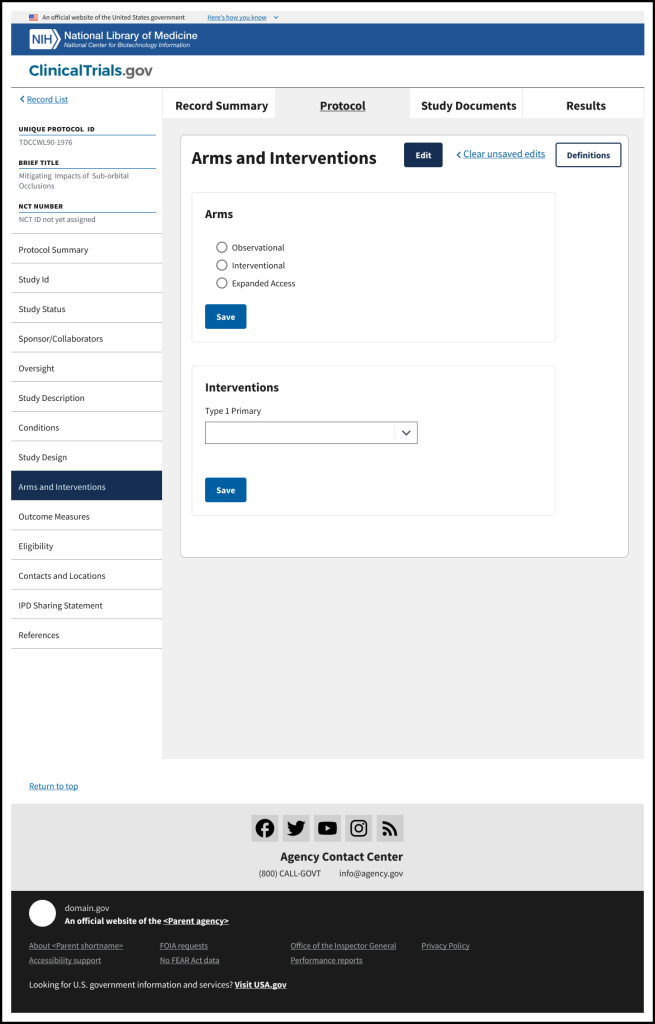
The National Institute of Health’s (NIH) ClinicalTrials.gov web site is hindered by numerous, critical experience and technical challenges.
Tactical Objective: Arms & Intervention Task Improvement
The new design for the “Arms & Interventions” task flow improves the form submission experience by leveraging multiple UX policies resulting in a increased rate of submission acceptance by the QA authority.
This task flow was responsible for 13% of user submissions failing approval.
The solution takes advantage of a new information architecture, a upgraded technical infrastructure, applies standard UI conventions and employs a new service model.
Design Leadership, Product Management
I initiated these strategies to identify and prioritize design work for my team:
- Ongoing usability and heuristics analysis of legacy application.
- Implemented Lean UX practices.
- Began sponsoring workshops to review my analysis with the team and coach the Product Owner on feature prioritization.
- Representing design stories in the backlog
- Rapid prototyping milestone reviews
- Cross-functional collaboration -requiring visibility into Content Strategy cadence
- Scheduling & executing UX Research
Service Ecosystem
Environment
Clinical research is medical research that involves people.
Clinical trials are part of clinical research, they look at new ways to prevent, detect, or treat disease.
The National Institute of Health (NIH) oversees clinical trials.
System
The PRS, Protocol Registration and Results System, is the data entry and review system used to submit study data to the team that manages ClinicalTrials.gov.
Users
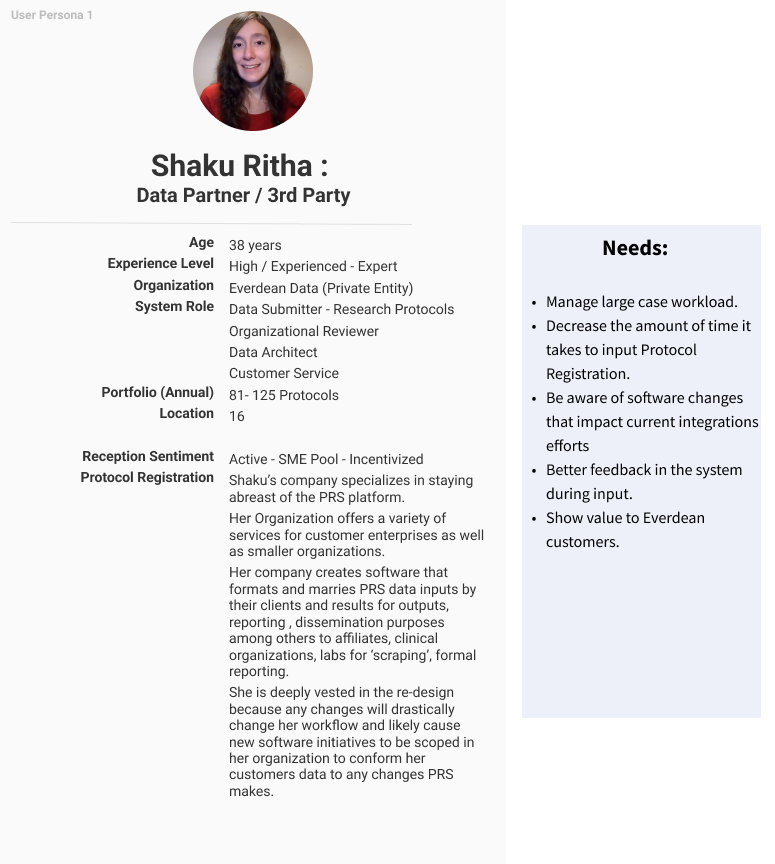
Data Submitters {Responsible Parties (RPs)}:
Register their studies, submit summary results information, and communicate with the ClinicalTrials.gov team in the PRS.
Process Decomposition
Who is this for?
What are users trying to accomplish?
Input the Arms & Interventions (A&I) data into a series of forms for your protocol.
Data Submitters most frequent task complaints:
- Navigating through the site to the task.
- Navigating through task flows and individual pages.
- Lack of UI feedback and cumbersome to recover from errors.
How do users accomplishing this?
Journey Mapping
Walking beside our user to understand the steps they take and to empathize with their frustrations:
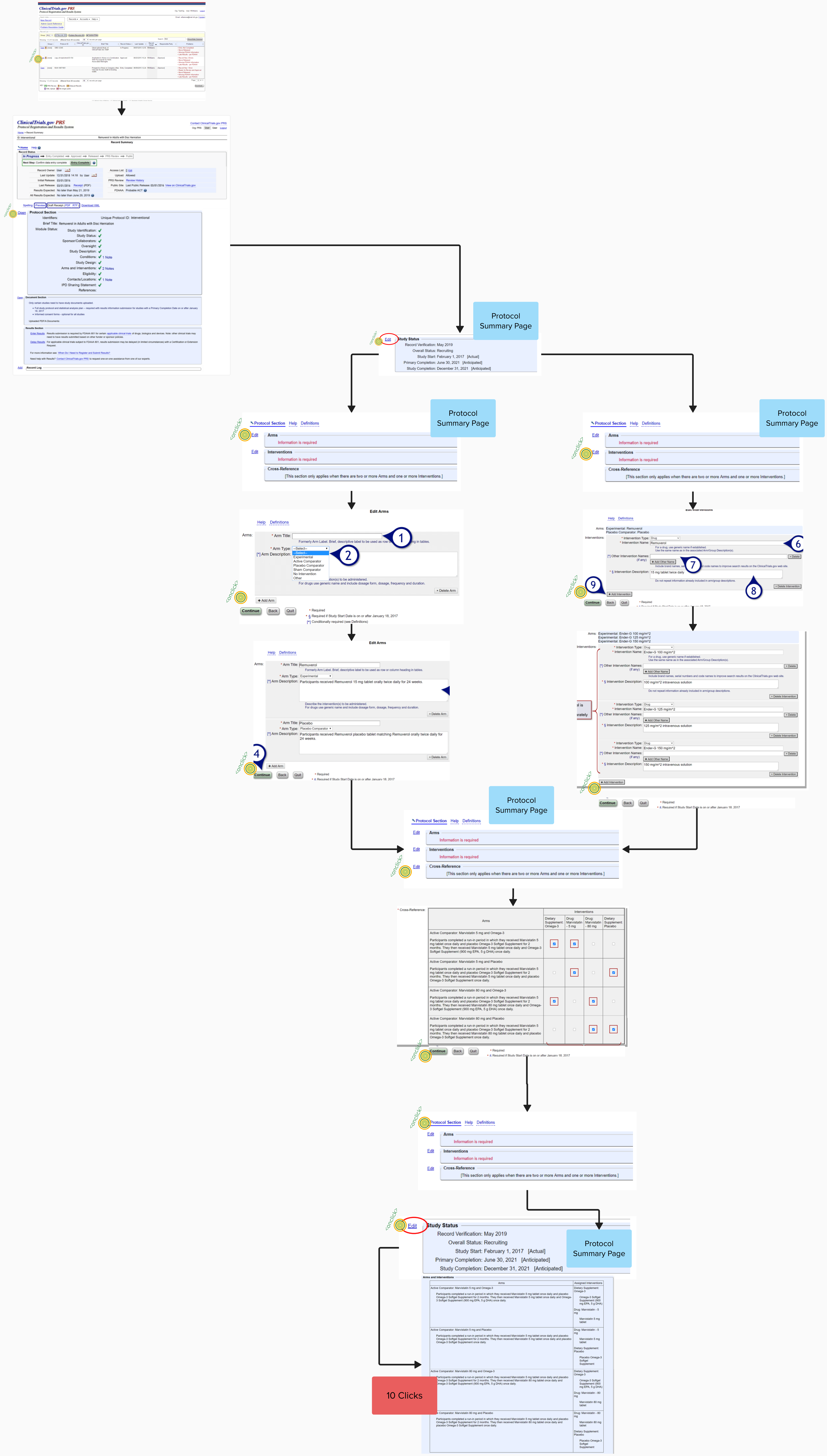
Navigating through the Arms & Interventions task model involves going through a minimum of 9 pages, each with multiple steps.
The complexity and dependencies of our protocol informs the ultimate limit of how many data types may have to be added. (n+1)
Our data shows protocols with over 30 data amendments is not uncommon, meaning repeating this task 30 times.
Click Path Analysis
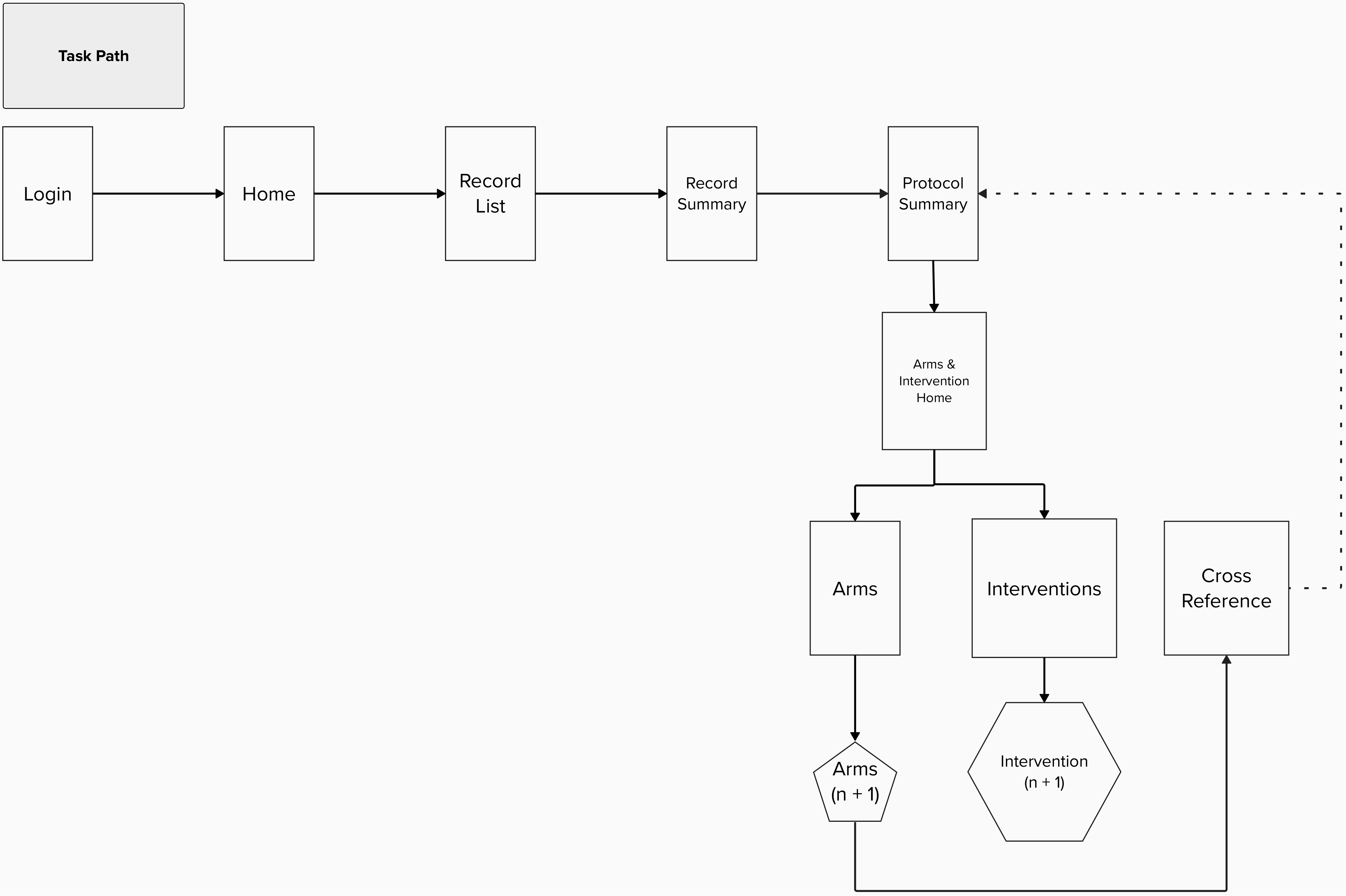
I captured the Click Path required of a user to illustrate some crucial points to the team:
At least 10 clicks are required to navigate the Legacy Information Architecture (IA) to engage the Arms & Interventions form
Users must navigate up, down, back and forth through the IA to complete the task.
The process is frustrating, violates best practices and taxonomical conventions of discovery, locality & proximity.
Taxonomical Swimlanes
I built a case with data and evidence to convince the team we need to implement a smarter Beta IA, not re-skin the Legacy experience.
As a data submitter, if I input incorrect data on a page in level 6 I have to navigate 3 levels to be notified.
Illustrating navigating the taxonomy for the team.

Systems Mapping in support of technology improvements that improve stability and enhance the service experience.
selecting image will open it in a new window.
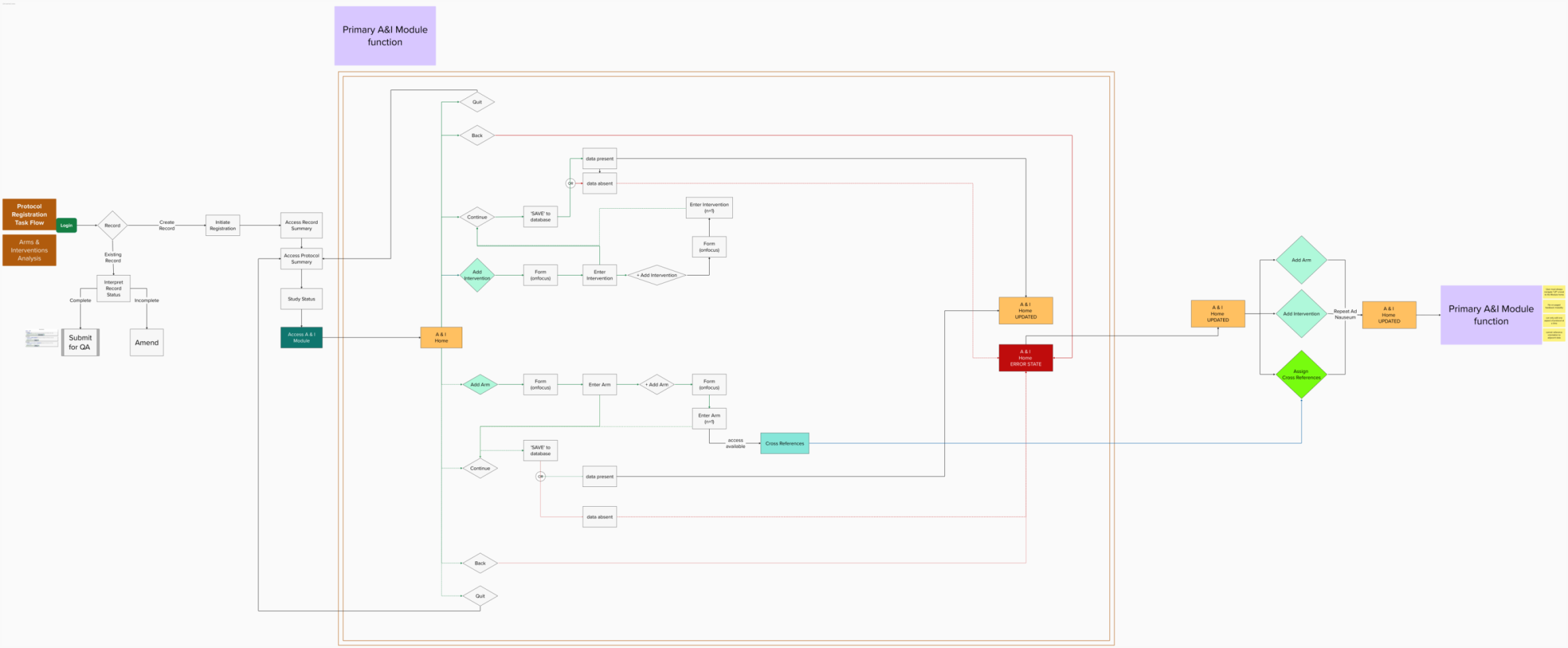
To support the migration to a event driven architecture I captured the technical interactions and trigger points to help the team align.
Supported a UI content audit assuring design did not overlook any interactions in the update.
Exploratory conversations revealed the need to establish USABILITY POLICIES that would support the application of new patterns in the modernized application environment.
Service Refactoring, Streamlining and Solutioning
Information Architecture
Informed by card sorting, tree tests and journey mapping, I authored a new information architecture.
- It is a hybrid application of the Hierarchical Model at taxonomical levels 1-3.
- The distinct local form flows are based on the Sequential Model.
- The status, views and crucial Record Summary are based on the Hub and Spoke Model, enabling users to access different sections through links from the central hub.
- My model rectified the important “VIEWS” function.
- Paired with asynchronous requests, users receive feedback in the DOM and their input is instantly refreshed.
- Arms & Interventions is now completely nested within the immediate, discrete task local.

No more jumping around the taxo levels!!
Usability Policies
I authored a set of guidelines that tied UI elements, system responses and data warehousing activities together and created behavioral consistency.
“Save Policy”
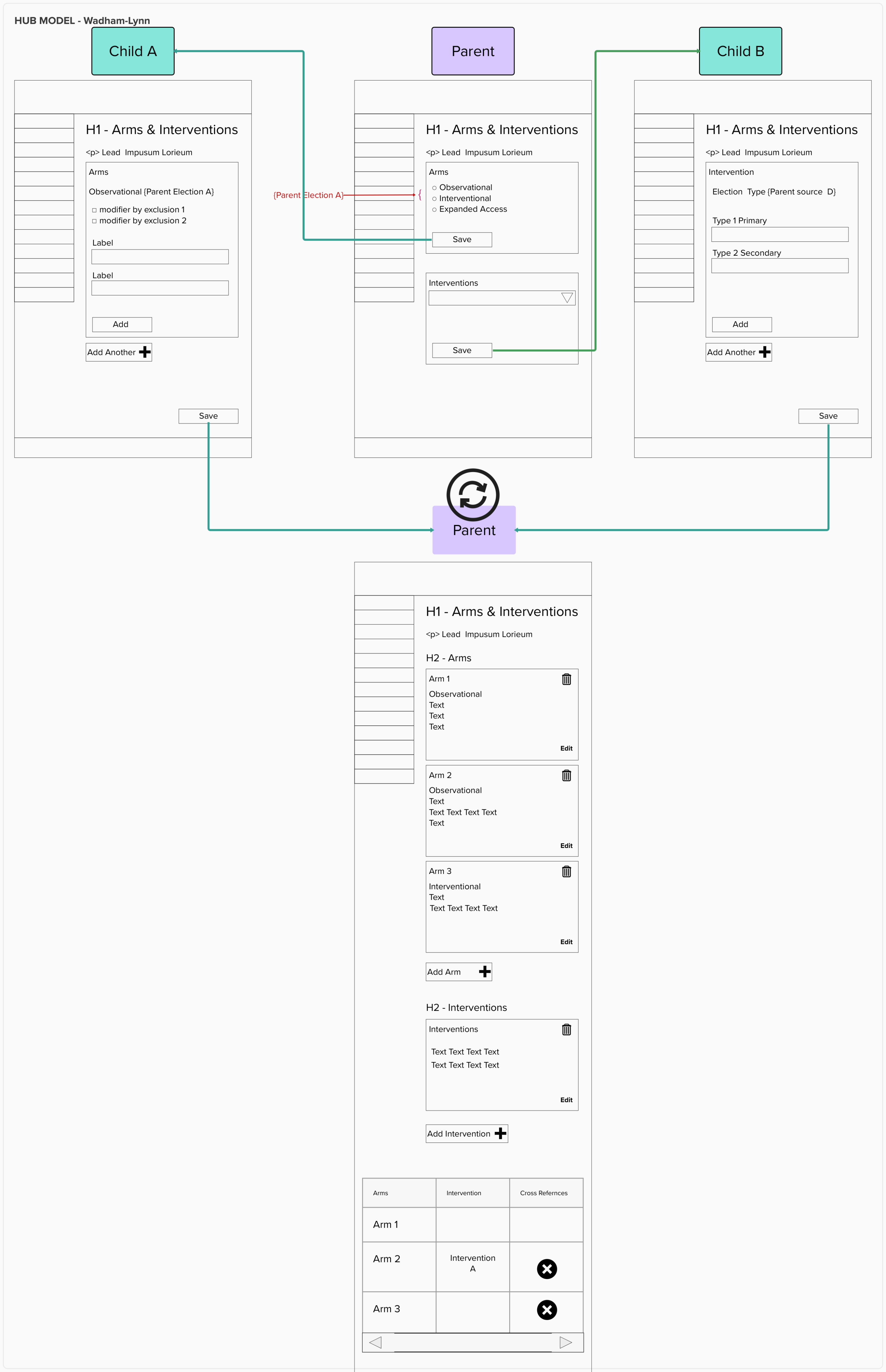
Parent – Child Hub Model; page level
“Error Handling” co-authored with my Sr. Designer
Save Policy
I sponsored a series of workshops and working closely with my Business Analyst, Development Engineer and Product Owner, authored a framework of rules stipulating how the ‘SAVE’ functionality operates.
- Button labeling / design / placement
- The impact of Error Handling on parsing data ingesting
- Session policies
- Log In/Log Out
- Data warehousing
- User Expectations / Usability Guidence
Hub Model
All of these building blocks culminate in a new application service delivery pattern I title “The Hub Model”
Based on basic traditional programing architecture, the model utilizes a Parent – Child relationship at the page level.

A couple of rounds of negotiation and refinement resulted in adoption of this solution.

Takeaway
I gained tremendous confidence completing this effort.
I had to assume a leadership role to align the team and get work to the ‘done’ state, and this required challenging myself in both a technical capacity and also soft skills.
I am very pleased with the outcome of the solution and the improvements it realizes for the NIH Data Submitters.
