UX Research and Experience Architect:
Charles Schwab
Realizing improved outcomes by digitizing essential workflows.
Reduced all-paper Power of Attorney role submissions by over 70%.
Year 1 Launch: Empowered over 215,000 digitally submitted role additions.
As part of the Digitized Workflow initiative, our objectives are to empower customers to manage the access to their accounts and reduce the burden of traditional paper driven workflows.
Role
Year
Deliverables
-
Stakeholder interviews
-
Workshops
-
UX Research Synthesis
-
Findings, Insights, Recommendations
-
Task Flows
-
Product & Design Requirements
-
Prototypes
-
Delivered Solution


Digitization of the client enrollment experiences delivered a big impact for for our customers.
Problem Statement
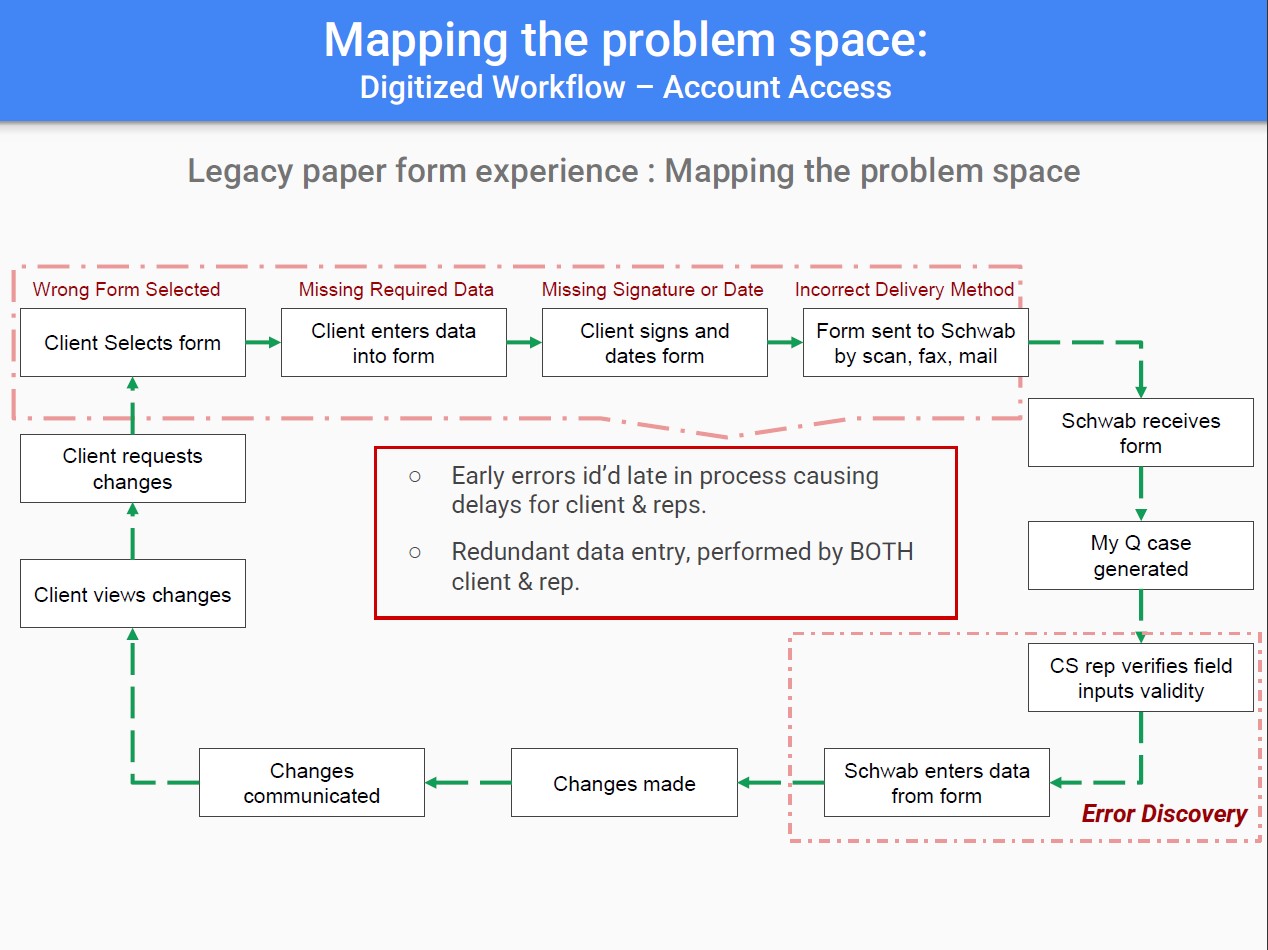
The legacy methods of capturing data from clients by paper forms lends itself to errors, delays, re-work and decreased customer satisfaction.
Business Objective
Workflow Digitization
Transitioning the input, capture, processing and maintenance of workflows into digitized solutions realizes improved outcomes for everyone.
Discovery
Interviews: Internal Stakeholders
Understanding the problem space, user needs, and project goals to ensure alignment and clarity before proceeding with design.
-
For our customers:
Forms Digitization will enable the electronic capture of all information and provide users with abilities to manage & provide signatory authority upon their information.
-
For the business:
- Reduces unnecessary account and profile changes, decreasing processing time and increases accuracy.
- Creates scalable solution for clients & partners in operations, removes redundancy, improves compliance adherence and improves CX.
Interviews: Customers
Contextual Inquiry & surveys
Supported by other research associates efforts as well as a repository of secondary research, we had qualitative and quantitative data available to construct user types, personas and draw reasonable deductions on customers behaviors, expectations and pain points related to account access.
SME & Stakeholder Workshops
Secondary analysis, synthesis, contribution and insights based upon previous UX Research.

Building on observations from SMEs and interviews with Schwab Investment Consultants (IC), the previous UXR executed empathy mapping workshops.
Visualizing the archetypes of the customer and IC helped the team focus on user thoughts, feelings, actions, and motivations.
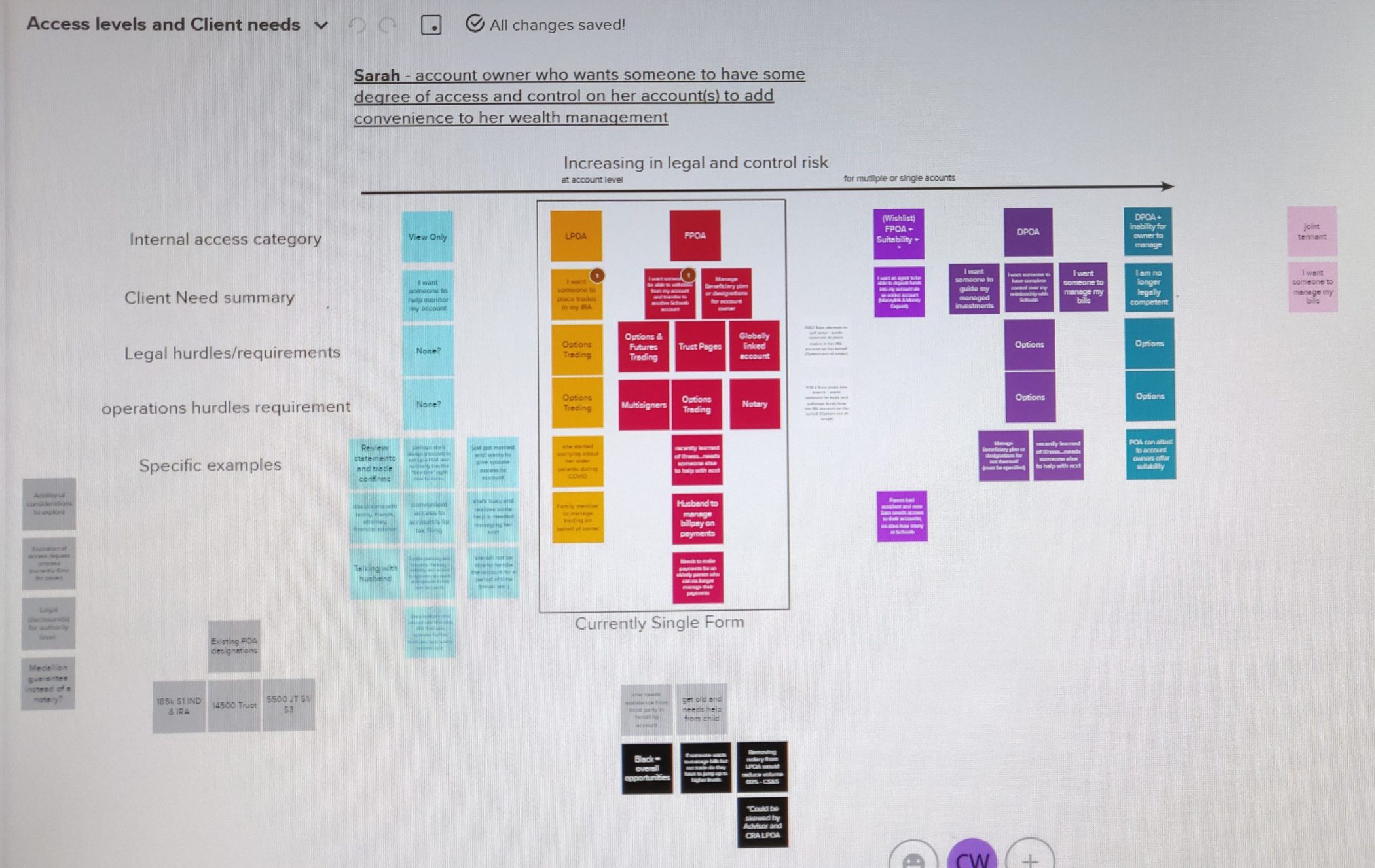
Prior to my joining the team, extensive discovery in the form of JTBD / needs assessment matrix uncovers that customer needs dictate what Power of Attorney is appropriate.
The permission levels impact account administration in different ways.
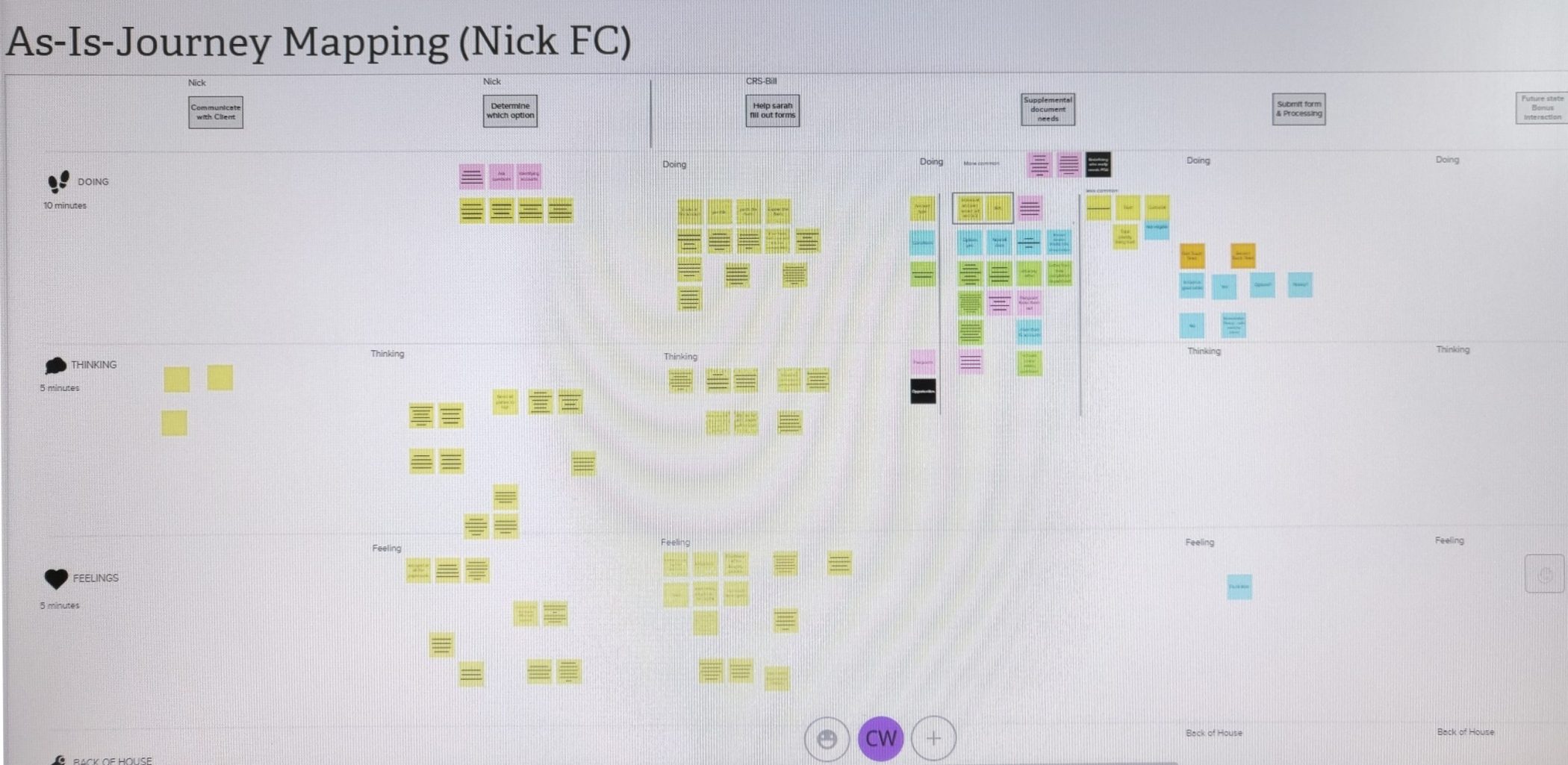
Financial Consultant Journey Mapping
UX and Product partners mapped the experience journey based on interview and survey input.
This was instrumental in communicating the many points in the process the traditional workflow broke down for Financial Consultant (FC) partners.
Exploratory
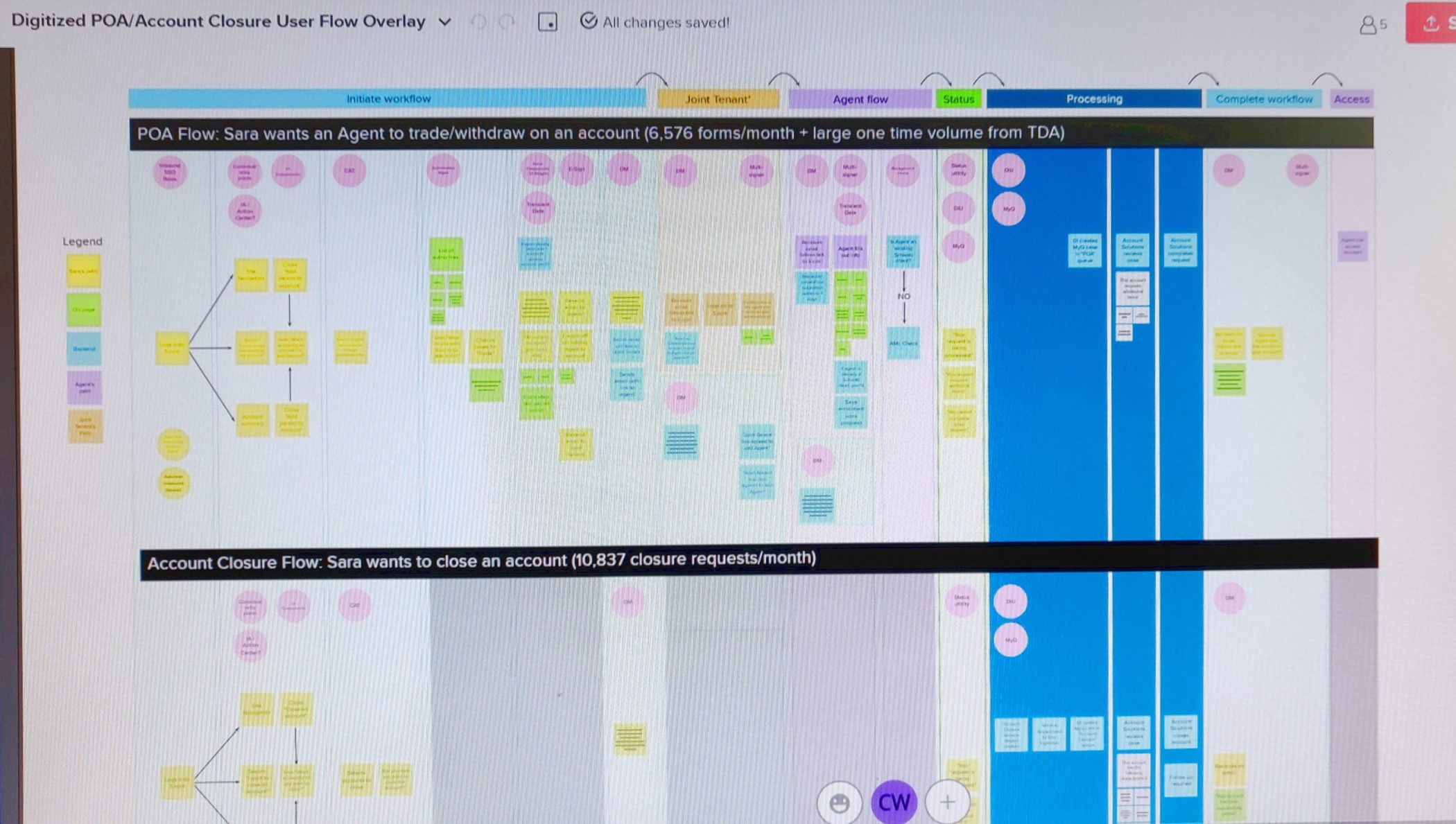
We can see how many steps in each process are invoked for specific Power of Attorney (POA) tasks.
The volume of forms generated monthly has a high impact on overhead and resource allocation.
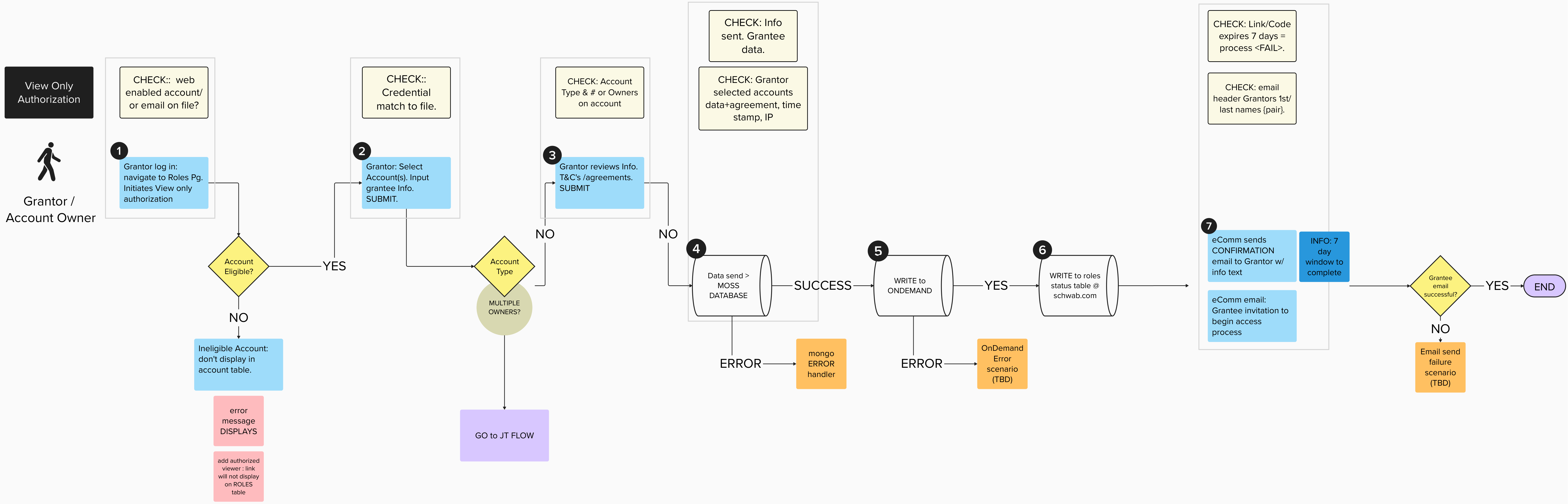
Architecting the Account Owner user journey and data interaction (View Only Access)
Service Architecture (SA)
Partnering with BA, PO & Technical Architect
Highlighting friction points in the paper form process based on discovery and exploration of the problem space.
Iterative Design & Research
Content Strategy & Labeling
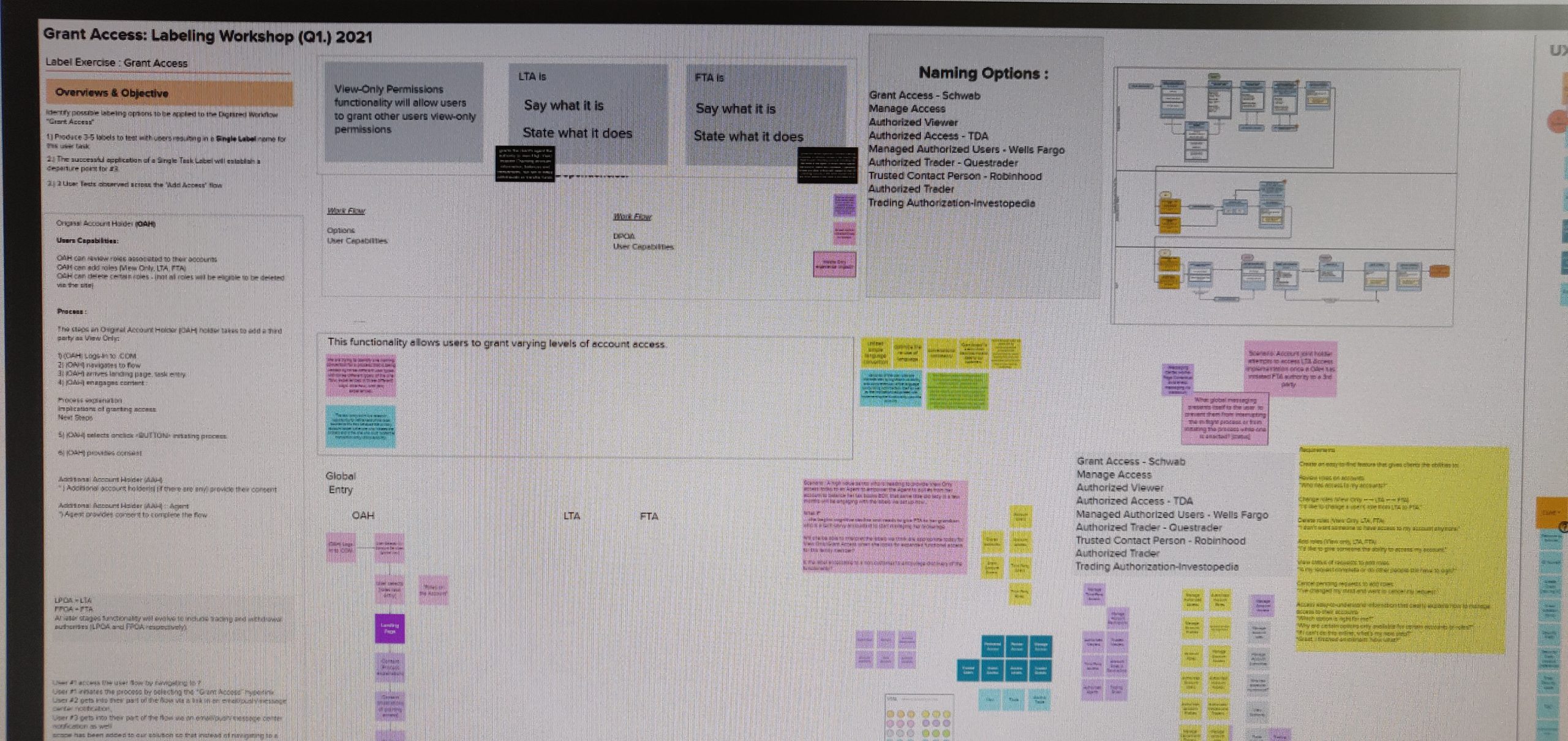
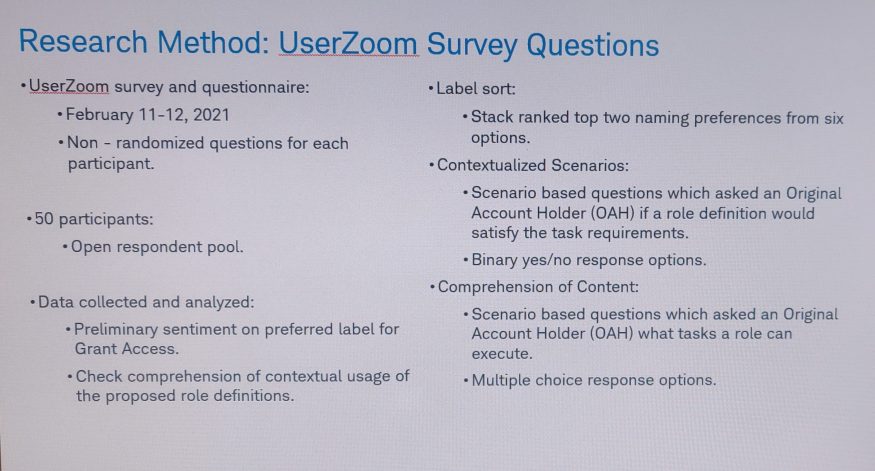
Labeling Workshop
Together with my Content Strategist, we bring the team together to discuss how to name permissions.
I use the prioritized options to drive the programming for my lexicon testing with users.
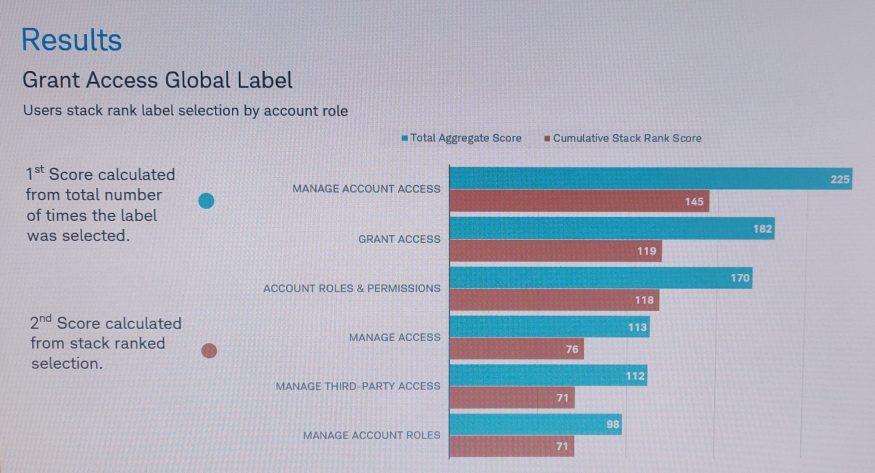
Unmoderated lexicon & labeling study
-
1-Entry-GrantAccessLabelingOptions
-

2-GrantAccessLabelingOptions
-
3-Exec SummryGrantAccessLabelingOptions
-

4-Recmmndtns-GrantAccessLabelingOptions
-
5-Method-GrantAccessLabelingOptions
-
6-Results-GrantAccessLabelingOptions
-

7-Resultrank-GrantAccessLabelingOptions
-

8Label Rank-GrantAccessLabelingOptions
-

9Rank–GrantAccessLabelingOptions
-
10-Feedback-GrantAccessLabelingOptions
-

11Aggrgt–GrantAccessLabelingOptions
Findings
-
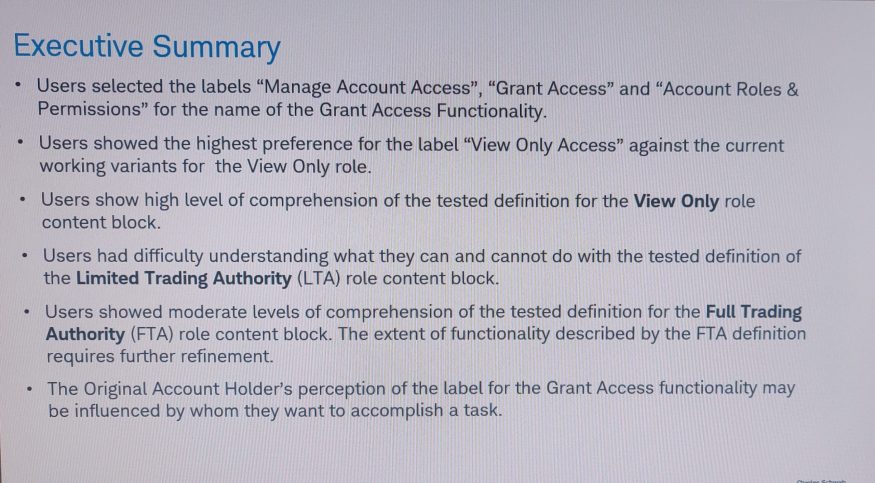
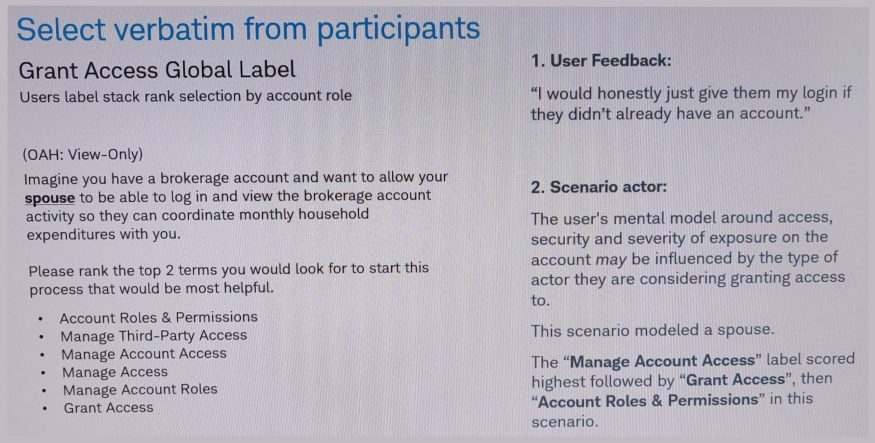
From feedback we learned the jargon heavy, legally specialized lingo account access, power of attorney and account interoperability language are intimidating to users.
-
Users are uneasy with the unfamilar knowledge domain and become easily confusion by the terminology of the account access process.
Discoverability, findability & information architecture
Information Architecture
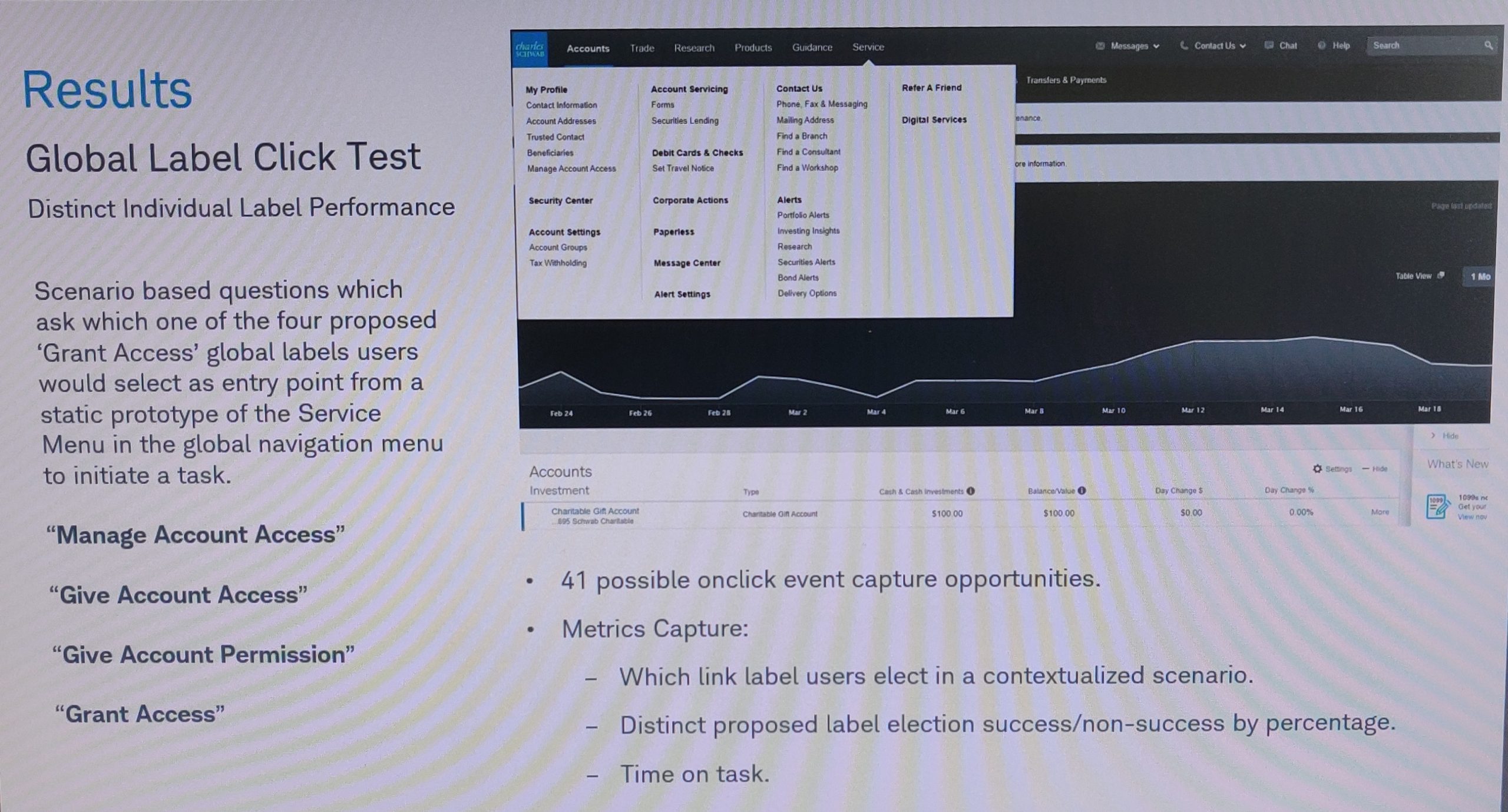
To identify the ideal location to locate the task entry I authored several IA and taxonomical studies.
Findings

The label “Grant Access” performed the best of the 4 options.
We proceeded to adopt this label into the design moving forward.
Design Validation
Iterative design and user testing
Desktop
-

P11-Results-Desktop1
-

P11-Results-Desktop2
-
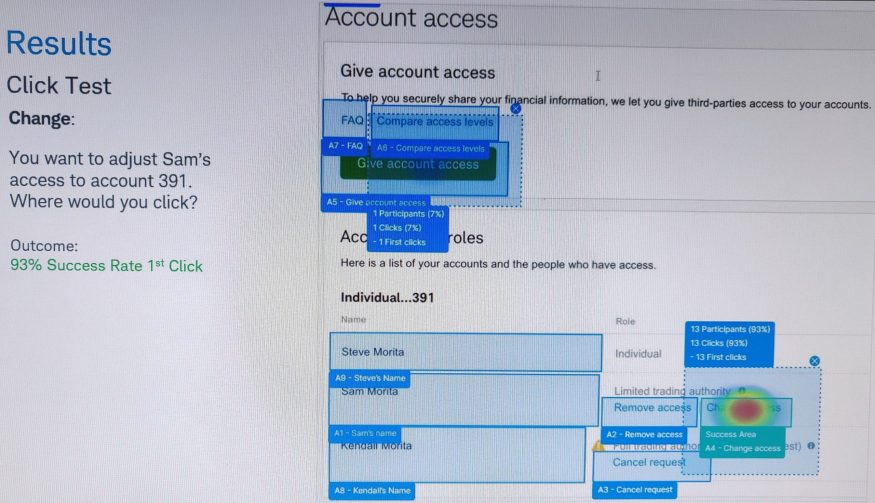
P11-Results-Desktop3
-

P11-Results-Desktop4
-

Results-Desktop2
Authored, executed, analyzed and presented insights and findings on a series of validation studies using a variety of qualitative and quantitative methodologies.
- Task flow challenges
- Touch point effectiveness
- Content / Design effectiveness
- SUS
- Design patterns
Mobile

Takeaway
Within the 1st year of launch the Account Access solution realized a reduction in paper based Power of Attorney role submissions by over 70%.
By empowering our customers to complete this process completely online, at least 215,000 users utilized this functionality to add roles to their account access.